
This is general information from published research, not medical advice.
For protein intake for fat loss, the number most of the research lands on is about 1.6 grams per kilogram of body weight per day, and the gains stop climbing much past that. What almost nobody gets right is the split: roughly 0.4 g/kg at each of four meals, not 90% of it at dinner. A kitchen scale and three days of writing things down will tell you which half you’re getting wrong.
The total is the easy part. Breakfast is where this falls apart.
Where the 1.6 g/kg number comes from
A 2018 meta-analysis in the British Journal of Sports Medicine pooled 49 trials and 1,863 people who lifted weights and added protein. It found a break point: past a total intake of 1.62 g/kg/day, extra protein produced no further gain in fat-free mass (Morton et al., 2018). More was not worse. It just stopped being more.
That’s the ceiling for building. Losing fat while holding muscle is a slightly different job, and it’s where the higher end earns its keep.
In a 4-week trial at McMaster University, 40 young men ate about 40% below their energy needs and trained six days a week. One group got 1.2 g/kg of protein a day, the other 2.4 g/kg. The high-protein group gained 1.2 kg of lean mass and lost 4.8 kg of fat. The low-protein group gained 0.1 kg of lean mass and lost 3.5 kg of fat (Longland et al., 2016).
Read that gap carefully before you copy the 2.4. Those men were training hard six days a week under a brutal deficit — the conditions that make protein matter most. For a moderate deficit and three gym sessions, 1.6 g/kg is the honest target, and the trial tells you which direction to move if your deficit gets steeper.
Why the split is what actually breaks
Muscle protein synthesis responds to a dose, not to a daily sum. Feed it too little in one sitting and that sitting mostly doesn’t count toward keeping muscle, no matter what the daily total says at midnight.
Reviewing the dose-response work, Schoenfeld and Aragon concluded you should target 0.4 g/kg per meal across at least four meals, which lands you at 1.6 g/kg/day by arithmetic (Schoenfeld & Aragon, 2018). Push the daily total to 2.2 g/kg and the per-meal figure rises to about 0.55 g/kg.
Now put a typical day against that. Coffee and toast is 8 grams. A sandwich at noon is maybe 20. Then a chicken dinner delivers 55, and a protein shake before bed adds 25. Total: 108 grams — a respectable 1.5 g/kg for a 70 kg adult, and two of the four meals were below the threshold anyway.
The daily number looked fine. Half the day did nothing.
I only found this in my own week because the notebook was already open. I’ve kept one on the kitchen counter since 2021 for grip and resting heart rate, so I started writing a protein number next to each meal in the same column. Three days in I stopped logging, because there was nothing left to learn. Dinner was always fine. Lunch was usually fine. Breakfast was coffee, and coffee is zero. What I had filed in my head as a daily-total problem was one meal, every day, and I had never seen it because I only ever added the day up at night. The fix was eggs. It was not a diet.
How to count protein intake for fat loss at home
This takes three days, not a subscription. The point isn’t to log forever — it’s to find out where your day is empty, fix that one meal, and stop counting.
- Get your per-meal target. Body weight in kg × 0.4. For 70 kg that’s 28 grams, four times a day. If you think in pounds, divide by 2.2 first.
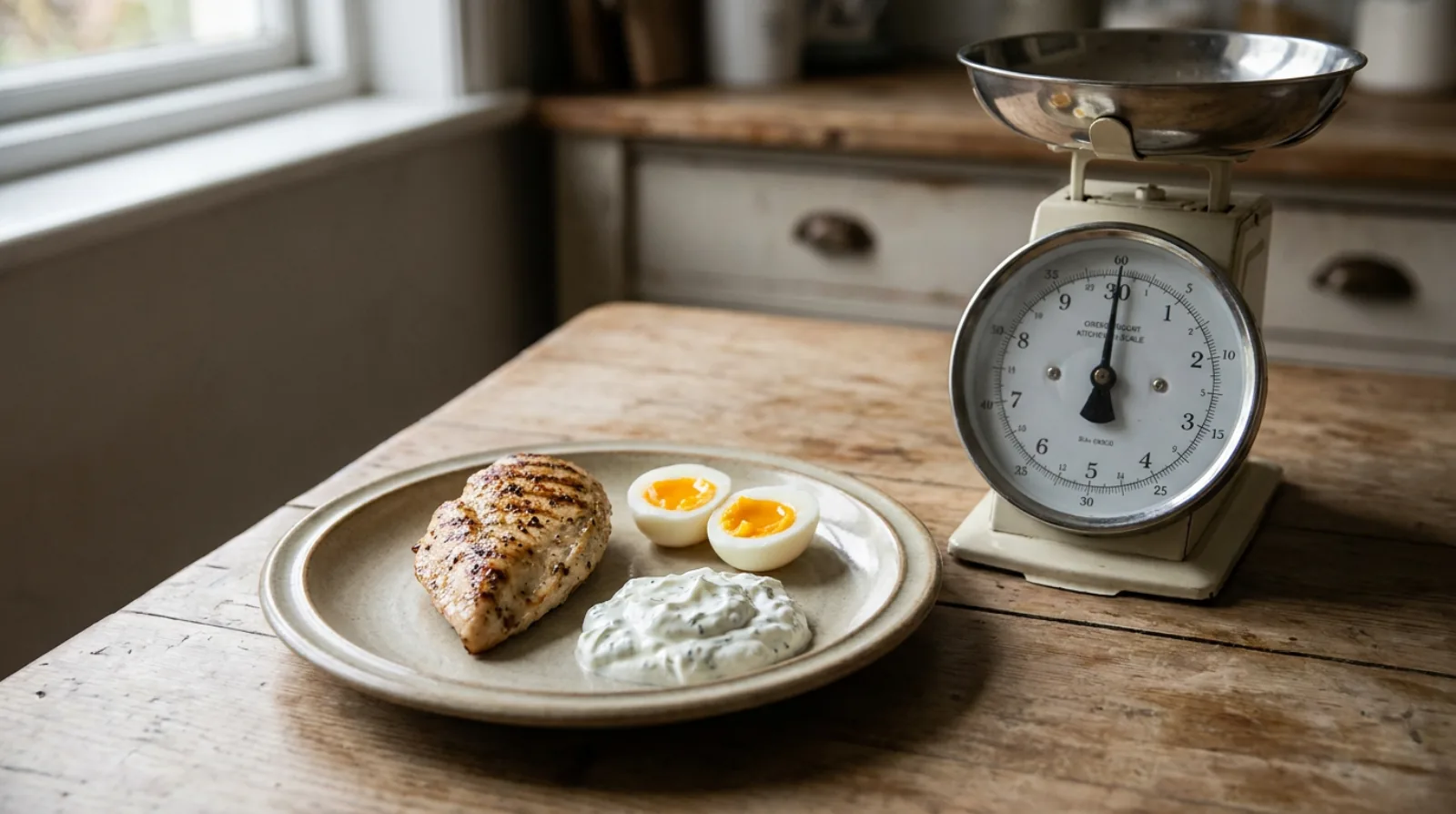
- Weigh three foods once, not every meal. Put your usual chicken portion, your usual yogurt, and your usual scoop on a kitchen scale one time and write the grams on a card. Weigh cooked or weigh raw, but pick one and stay with it — chicken loses about a quarter of its weight in the pan. After that you’re estimating against something real instead of against a guess.
- Log three days, including one weekend day. Protein per meal, nothing else. No calories, no macros, no app. A phone note works.
- Circle the meals under target. For most people it’s breakfast, and it’s not close — 8 to 12 grams against a 28 gram target.
- Fix the worst meal only. Three eggs plus a cup of Greek yogurt is about 38 grams and takes six minutes. Changing one meal moves the daily total more than a new diet does.
- Re-check in four weeks. Same three-day log, same conditions. You want to know whether the fix stuck.
Here’s the target table.
| Body weight | Per meal (0.4 g/kg) | Per day (1.6 g/kg) |
|---|---|---|
| 60 kg / 132 lb | 24 g | 96 g |
| 70 kg / 154 lb | 28 g | 112 g |
| 80 kg / 176 lb | 32 g | 128 g |
| 90 kg / 198 lb | 36 g | 144 g |
For reference: a cooked 6 oz chicken breast is roughly 50 g, three eggs about 18 g, a cup of Greek yogurt about 20 g, a whey scoop about 25 g.
When 1.6 g/kg is the wrong number for you
Two situations move the target, and one of them means you stop reading blog posts and call someone.
If you’re already lean and cutting further — a physique athlete, someone under 15% body fat dropping weight — a systematic review of resistance-trained athletes in a deficit put the requirement at 2.3 to 3.1 g/kg of fat-free mass, scaling up with how lean you are and how steep the cut is (Helms et al., 2014). Note the denominator changed: that’s per kg of lean mass, not body weight. Using it on total body weight when you’re carrying extra fat will hand you a target you could never actually eat.
The other direction matters more. If you have reduced kidney function, are on dialysis, or have been told to watch your protein for any medical reason, none of the numbers on this page apply to you — ask the clinician who told you that. Same if you’re pregnant. And if you’re losing weight without trying, or losing strength while eating well, that’s not a protein-counting problem. Get it looked at.
Muscle you keep is also strength you keep, and strength is measurable at home too — the grip strength test takes five minutes and tracks something protein alone won’t tell you. Both sit on the same list: what’s worth measuring at home, and how often.
Do this today
Multiply your weight in kilograms by 0.4, write that one number on a card on the fridge, and check tomorrow’s breakfast against it. That’s the whole first step.
If breakfast comes in under, you found your problem in one morning.

I am not a doctor. Since 2021 I have been tracking my own grip strength, resting heart rate, blood pressure and sleep at home, and reading the studies behind each number. This site is what I wish I had found when I started: how to measure, what the ranges mean, and when a number is worth a visit to a clinician.